

What Trees Attract Cardinals Most? 12 Backyard Favorites

Northern Cardinals are most attracted to dense, food-producing trees that offer year-round cover and accessible nesting structure. Evergreen trees like cedar and pine provide shelter, while berry-bearing trees such as dogwood and mulberry supply reliable food. The most effective trees combine protection, nesting support, and seasonal nutrition.
If you’re asking what trees attract cardinals most? the answer centers on structure and food. Cardinals prefer thick, low-to-mid level branching, protective foliage, and trees that produce seeds or berries. Selecting the best trees for northern cardinals means focusing on habitat function-not just appearance.
Key Takeaways
For a complete backyard plan beyond tree selection, read our Cardinal Habitat guide covering shelter, food, nesting cover, and layout strategy for Northern Cardinals.
Why Trees Matter to Northern Cardinals?
Understanding trees cardinals prefer most requires looking at how cardinals use trees across seasons. Trees are not just perches; they are shelter systems, nesting platforms, food sources, and territorial anchors.
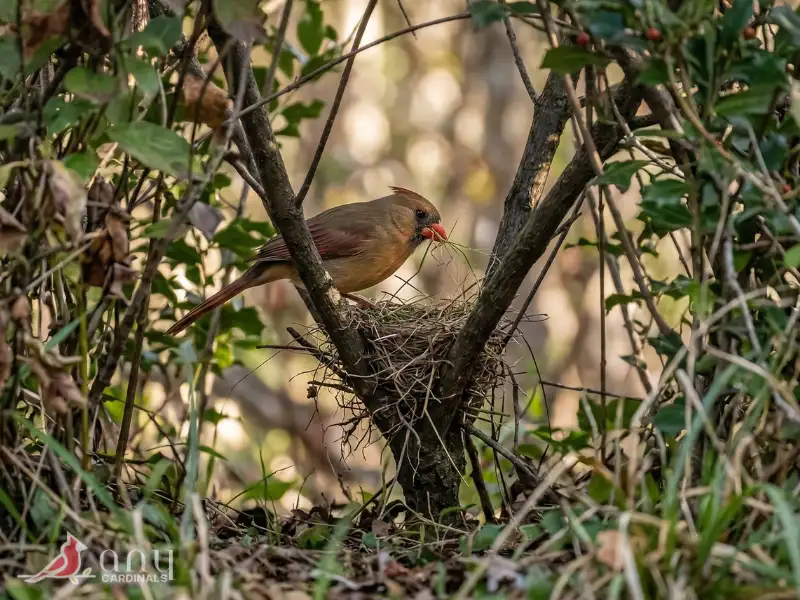
Nesting Structure Preferences
Northern Cardinals typically build nests 3–10 feet above ground in dense vegetation. According to field data from the Cornell Lab of Ornithology, cardinals favor thick shrubs and small trees with forked branches that can support a cup nest. Sparse canopy trees with open branch spacing are rarely used.
The ideal nesting tree offers:
- Dense outer foliage for concealment
- Interior branch forks for nest support
- Mid-level height within shrub layers
This structural density explains why evergreens and compact deciduous trees outperform tall ornamental species.
Shelter From Predators
Cardinals are vulnerable to hawks, owls, snakes, and domestic cats. Dense foliage reduces aerial visibility and provides escape cover. Observationally, cardinals retreat quickly into evergreens when threatened. Trees with year-round foliage provide consistent predator protection.
Seasonal Food Dependence
Cardinals eat seeds, berries, and insects. Trees that produce fruit or host insect populations increase feeding opportunities. Native trees support more insect biomass, especially during breeding season when protein demand rises.
Evergreen Trees Cardinals Prefer
Evergreens rank highest among the best trees for northern cardinals because they provide year-round protection.
Eastern Red Cedar
One of the top answers to What trees attract cardinals most? is Eastern Red Cedar. It offers:
- Dense foliage
- Mid-level nesting zones
- Blue berry-like cones in winter
These trees serve as both shelter and seasonal food source.
Pine Trees
White pine and loblolly pine provide thick branch clusters ideal for roosting. Although pine trees do not offer berries, they create strong structural concealment. Cardinals frequently use pines during winter storms.
Spruce and Fir Trees
Spruce and fir trees offer compact needle density. In northern regions, these trees provide winter refuge. While less common nesting sites than cedar, they still rank among trees cardinals prefer most for shelter.
Arborvitae
Arborvitae hedges mimic natural evergreen thickets. In suburban yards, they function as artificial edge habitat—a known cardinal preference.
Top Evergreen Trees That Attract Cardinals
- Eastern Red Cedar
- White Pine
- Loblolly Pine
- Spruce
- Fir
- Arborvitae
Fruit & Berry-Producing Trees Cardinals Love
While evergreens provide structure, fruit trees provide nutrition.
Dogwood
Flowering dogwood produces red berries in fall. These berries serve as seasonal fuel before winter. The branching pattern also supports nesting.
Mulberry
Mulberry trees offer high-energy fruit during breeding season. Cardinals are frequently observed feeding on ripe berries, especially in early summer.
Serviceberry
Serviceberry produces early-season berries. This timing aligns with nesting season when adults need additional energy.
Crabapple
Crabapple trees hold fruit into winter. Although not a primary nesting tree, they function as reliable winter-feeding stations.
These fruiting trees reinforce why habitat diversity matters. A yard with only evergreens lacks seasonal nutrition.
Native Trees vs Ornamental Trees
Not all attractive landscaping trees are attractive to cardinals. The difference is usually ecological function.
Why Native Trees Perform Better?
Native trees typically support more insects, and insect availability matters most when cardinals are breeding. During nesting, adults shift from “mostly seeds and berries” to “more insects for chicks.” A native tree that supports caterpillars and other prey can raise a yard’s nesting value fast.
Native trees also tend to:
- Match local seasonal timing (fruiting, leaf-out, shelter patterns)
- Require less chemical support (healthier insect base)
- Fit naturally into edge habitat structure
When Ornamentals Still Work?
Ornamentals can still help when they provide real structure or fruit. A fruiting crabapple or dense evergreen hedge can be valuable even if it’s not native. But sterile ornamentals with open branching—trees chosen purely for appearance—rarely contribute much to cardinal nesting success.
To avoid cannibalization, keep “native plants” as a supporting section here, and link internally to a separate post like “Best Native Plants for Northern Cardinals” if you publish it later.
Scientific Insight – What Habitat Studies Show?
Across bird ecology work and large-scale monitoring (including major survey efforts), Northern Cardinals are strongly associated with edge habitat-places where woodland meets open areas, hedgerows, fence lines, and shrubby transitions.
That matters because backyard landscapes often replicate edge habitat when they include layered plantings rather than a single isolated tree.
What this means in practice?
- Cardinals are more likely to nest where mid-level cover exists, not in exposed canopy.
- Dense vegetation improves concealment and reduces predator visibility.
- Habitat complexity (layers) increases feeding opportunities and safe movement.
If you want a tight internal link here, use something like: “For nesting behavior and placement patterns, see where do northern cardinals nest?” That keeps this article focused on trees while guiding readers to the deeper nesting topic.
Trees Cardinals Avoid
Understanding which trees cardinals avoid helps clarify what they truly need in a nesting site. By examining the types of trees, they ignore, we can better identify the structural features that actually attract and protect them.
High Canopy Oaks Without Understory
Oaks support insects and acorns, but without dense lower growth, they lack nesting concealment. Cardinals may forage nearby but rarely nest high in open canopies.
Isolated Decorative Trees
Single ornamental trees in open lawns provide minimal shelter. Cardinals avoid exposed areas due to predator visibility.
The pattern is consistent: structure density matters more than height.
Designing a Backyard Tree Strategy
If you want to implement what you’ve learned about What trees attract cardinals most? focus on layered habitat.
The 3-Layer Habitat Formula
- Canopy Tree (oak, maple, pine)
- Dense Mid-Level Tree (dogwood, cedar)
- Shrub Layer (holly, viburnum)
This system mimics natural woodland edges.
Tree Spacing & Territory Size
Cardinals are territorial, especially in breeding season. Don’t plant “one feature tree” and leave everything else open. Instead:
- Cluster cover where you want birds to feel safe
- Keep feeding areas within quick flight distance of dense cover
- Use tree lines, corners, and fence edges to create protected lanes
A simple rule: wherever you place a feeder, make sure cardinals can reach thick cover in a few seconds.
The 12 Proven Backyard Favorites
Here’s a clean, practical list aligned to What trees attract cardinals most? and built around food + cover:
If your yard can only support 3 trees, prioritize: one evergreen (cover), one berry tree (food), one dense mid-level option (nesting structure).
Comparison: Which Trees Perform Best for Cardinals?
| Tree Type | Provides Food | Nest Cover | Winter Protection | Best Use |
| Eastern Red Cedar | Yes | Excellent | Excellent | Year-round |
| Dogwood | Yes | Good | Moderate | Nesting + Food |
| Pine | No berries | Excellent | Excellent | Shelter |
| Mulberry | Excellent | Moderate | Low | Summer feeding |
| Crabapple | Yes | Moderate | Moderate | Winter food |
Related Blog About Cardinals Habitat:
Frequently Asked Questions
Do Cardinals Prefer Evergreen or Deciduous Trees?
Cardinals prefer evergreens for nesting and winter shelter because of dense foliage. Deciduous trees play an important seasonal role, especially if they produce berries. Ideally, both types should exist in the same yard. Evergreens provide protection. Deciduous trees offer food diversity. A mixed system supports year-round survival.
What Tree Do Cardinals Nest in Most Often?
They frequently nest in Eastern Red Cedar, dense dogwood, and thick shrubs. Nest placement is typically between 3–10 feet high. Cardinals choose areas with heavy concealment. Sparse trees are rarely selected. Branch forks and dense foliage improve success rates.
Will Cardinals Use Oak Trees?
Cardinals may forage in oak trees due to insect presence. However, they typically avoid nesting in tall, exposed canopies. If oaks have understory shrubs nearby, nesting likelihood increases. Structure density is key. Oaks alone are not ideal.
Are Fruit Trees Good for Attracting Cardinals?
Yes. Mulberry, dogwood, serviceberry, and crabapple provide berries that cardinals readily consume. Fruit availability during breeding and winter improves visitation frequency. Fruit trees do not replace evergreens. They complement shelter trees.
How Tall Should a Tree Be for Cardinals?
Height is less important than density. Cardinals prefer mid-level nesting zones under 10 feet. Extremely tall trees with open canopies are less attractive. Dense branching matters more than vertical scale.
Do Cardinals Stay in Trees Year-Round?
Yes. Northern Cardinals are non-migratory in most of their range. They rely on consistent cover in winter. Evergreens are especially important during snow and storms. Territories are maintained throughout the year.
Can I Attract Cardinals with Just One Tree?
One dense evergreen improves odds, but layered vegetation works better. Cardinals require nesting cover and food. A multi-tree system replicates natural edge habitat. More structure equals higher occupancy likelihood.
How Long Does It Take for Trees to Attract Cardinals?
If habitat conditions are correct, cardinals may appear within a single season. Established territories take longer to form. Food, shelter, and safety must coexist. Mature trees increase success rates.
Final Word
If you want a direct answer to What trees attract cardinals most? prioritize dense evergreens like cedar and pine for structure, and berry-producing trees like dogwood and mulberry for food.
The best trees for northern cardinals combine protection, nesting support, and seasonal nutrition. Focus on layered planting rather than isolated ornamentals. When structure and food align, cardinals respond quickly-and often return year after year.