

Range of the Northern Cardinal – Distribution Across North America

The Northern Cardinal is native to much of eastern and central North America, with a range that stretches from southeastern Canada through the eastern and central United States and south into Mexico, northern Belize, and Guatemala. It is a largely nonmigratory species, so in places where it occurs, it is usually present year-round rather than only seasonally.
When people ask what is the range of the Northern Cardinal, they are really asking two things: where this bird naturally occurs, and why its distribution has expanded over time.
The short answer is that cardinals are now firmly established across much of the East and parts of the Midwest and South, with smaller but important populations in the desert Southwest and a growing presence in southern Canada.
Key Takeaways
- The Northern Cardinal range covers much of the eastern and central United States and extends into southeastern Canada, Mexico, northern Belize, and Guatemala.
- Northern Cardinals are generally resident birds, which means they do not make long seasonal migrations across their range.
- Their range has expanded northward and westward over time, helped by warmer winters, suburban habitat, and bird feeders.
- They are most common in woodland edges, thickets, backyards, hedgerows, and suburban gardens with dense shrubs.
- In Canada, the species is strongest in southern Ontario and southern Quebec, with expansion into parts of New Brunswick and Nova Scotia.
- West of the Great Plains, Northern Cardinals are mostly limited, though they occur locally in places such as southern Arizona and New Mexico, and introduced populations exist in Hawaiʻi and southern California.
Cardinals can thrive in many environments as long as food and shelter exist. Learn how cardinals live in urban areas, why they often prefer dense shrubs, which trees attract cardinals most, Cardinals in Canada and the natural predators cardinals face across different habitats.
Where Northern Cardinals Are Found in North America?
The Northern Cardinal belongs to a broad North American distribution centered on the eastern half of the continent. Its native range includes southeastern Canada, most of the eastern United States, large parts of the Midwest, the South, sections of the southern Great Plains, and then continues south through much of Mexico into northern Central America.
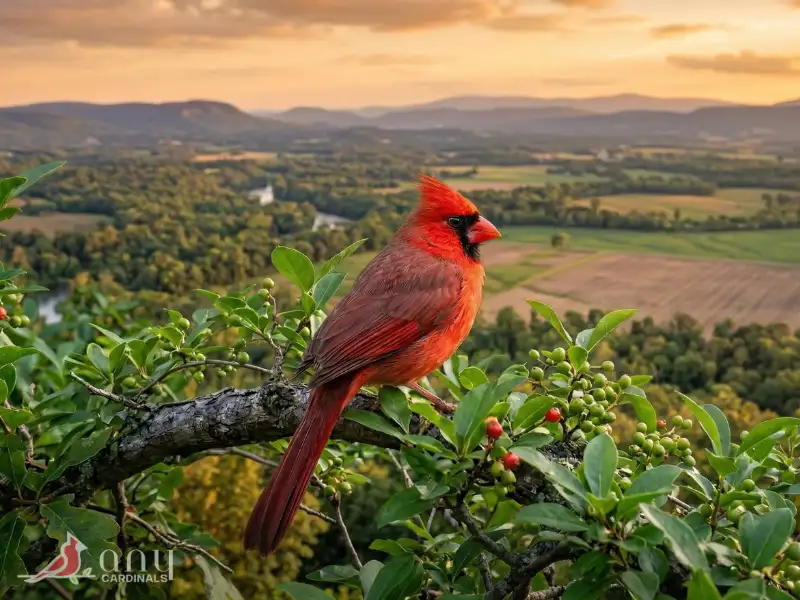
This broad distribution is one reason the species is so familiar to backyard birdwatchers. Unlike many birds with sharply seasonal appearances, cardinals stay visible across much of their range throughout the year.
That year-round visibility makes them seem even more widespread than many migratory songbirds.
At a field level, cardinals are most reliable where there is a mix of cover and openness. They favor dense shrubs for nesting and shelter, but they also use nearby open feeding areas, forest edges, overgrown fields, hedgerows, and landscaped yards. That habitat flexibility helps explain why the species occupies such a broad geographic footprint.
This broad distribution helps explain why the species is so familiar across much of North America. To understand their preferred environments in more detail, see Where Do Northern Cardinals Live and related habitat guides.
Northern Cardinal Range in the United States
In the United States, the core Northern Cardinal range lies in the East, Southeast, and much of the central region. The species is especially common from the Mid-Atlantic and Southeast through the Ohio Valley, lower Midwest, and south-central states. It is also one of the most recognizable resident birds in suburban neighborhoods across those regions.
The eastern United States remains the species’ strongest hold. Audubon notes that Northern Cardinals occur in a wide variety of brushy or semi open habitats in the East, from forest clearings and swamps to towns and city parks, provided there are dense bushes for nesting. That is why the bird is so common in both rural edges and developed neighborhoods.
In the Midwest, cardinals are also well established. They are not restricted to the deep South, which is a common misconception. Their range reaches broadly through central North America, and bird monitoring sources show that they remain abundant in many Midwestern landscapes where shrubby habitat, farm edges, and towns create suitable structure.
The western edge of the species’ U.S. range is more limited. West of the Great Plains, Northern Cardinals are mostly absent as a widespread native bird, but they are locally common in the desert Southwest, especially where streamside thickets, mesquite groves, and brushy washes provide cover. Southern Arizona and New Mexico are the main native western outposts people usually ask about.
Northern Cardinals in Canada
Northern Cardinals do live in Canada, but their Canadian range is much more limited than their U.S. distribution. Government of Canada species status material notes that the bird reaches Canada mainly in Ontario’s Carolinian region, then extends into eastern Ontario, southern Quebec, and parts of New Brunswick and Nova Scotia.
This is one of the clearest examples of recent range change. Canadian sources report that the species has increased in abundance and breeding range compared with the 1970s, based on Breeding Bird Survey and breeding bird atlas data.
In plain terms, cardinals are no longer just southern birds brushing the border. In some parts of southeastern Canada, they are now a regular year-round presence.
NatureCounts also describes the species as a year-round resident extending increasingly into Ontario, southern Quebec, and parts of the Maritimes, with roughly 1 million individuals in Canada.
That is still only a small share of the global population, but it confirms that Canada is now part of the established range rather than just an occasional northern fringe.
From a field observation perspective, Canadian cardinals are most consistently encountered where dense shrubs, backyard feeders, and winter shelter coincide. In practical birdwatching terms, the bird’s northern spread has not made it uniformly common across Canada. It remains concentrated in southern, more hospitable zones.
Northern Cardinal Range Map Explained
A Northern Cardinal range map is useful because it separates broad presence from local abundance. Cornell’s map materials identify the species as resident, while eBird explains that range maps show the areas where a species is estimated to occur during at least part of the year or season.
For cardinals, that matters because most of the mapped range reflects year-round occupancy rather than migration corridors.
At a high level, the map shows a strong eastern and central concentration, a thinner western limit, and a northward extension into southeastern Canada. It also shows that the species’ southern distribution does not stop at the U.S. border. Cardinals continue through much of Mexico and into northern Belize and Guatemala.
The scientific value of range maps is that they are built from large-scale observation and survey data, not just isolated sightings.
eBird Status and Trends and similar products help bird researchers detect shifts at the edge of the range, where expansion is easiest to measure. For a species like the Northern Cardinal, that is important because the story is not just where the bird is now, but how that footprint has changed over time.
A useful comparison table for readers is this:
| Region | Cardinal Status | General Pattern |
| Eastern United States | Very common | Core native range |
| Midwest and South | Common to abundant | Stable year-round populations |
| Southern Canada | Established but more limited | Expanding northward |
| Desert Southwest | Local native presence | More patchy and habitat dependent |
| Much of far West | Mostly absent natively | Exceptions are local or introduced |
| Mexico and northern Central America | Native | Southern continuation of range |
This table aligns with Cornell, Audubon, Canada species sources, and ABC range summaries.
Why the Northern Cardinal Range Has Expanded?
The expansion of the Northern Cardinal range is one of the most important parts of this topic. Cornell’s life history account states that the growth of towns and suburbs across eastern North America has helped the cardinal expand northward. The same source also notes the species’ use of ornamental landscaping, hedgerows, and backyards, which are common features of human-modified environments.
Canadian government material points to two likely drivers as well: bird feeding and warmer winters. That combination makes ecological sense. Feeders increase winter food reliability, while milder cold seasons reduce survival pressure at the northern edge of the range.
eBird trend materials strengthen that case by showing that Northern Cardinals appear to be increasing at the north and west ends of their range.
In the example highlighted by Cornell’s trend mapping, the species increased 13% in Texas and Oklahoma and 21% in Kansas over the last decade in the western edge context discussed there. That does not mean every local population rises equally, but it does confirm continued change at the range margins.
Cornell also notes a long-term increase of about 0.32% per year since 1966 in North American Breeding Bird Survey data. That is not an explosive growth rate, but across decades it is enough to reshape the bird’s regional footprint, especially in the north.
Habitats That Define the Cardinal’s Range
If you want to understand where Northern Cardinals are found, habitat is the key. Audubon describes the species in woodland edges, thickets, suburban gardens, towns, and, in the Southwest, desert washes and streamside brush.
Cornell similarly places them in dense shrubby areas such as forest edges, overgrown fields, hedgerows, backyards, marshy thickets, and ornamental landscaping.
That habitat preference explains why cardinals are often common in places people live. They do not require deep, unbroken forest. In fact, a patchwork of shrubs, edges, and openings often suits them better. Dense foliage gives them nesting cover, while nearby open ground, feeders, and fruiting vegetation provide food access.
From an observational standpoint, the bird is especially tied to structure at the eye level and below canopy level. In yards, that usually means evergreen shrubs, tangled vines, brushy borders, and thick ornamental plantings.
In the wild, it often means thickets, regenerating edges, and shrubby woodland margins. Where those conditions are missing, cardinals become much less dependable even inside the broader range.
Dense shrubs and layered vegetation also shape how cardinals use their environment. To understand these habitat patterns better, see Where Do Northern Cardinals Live and the trees they prefer in What Trees Attract Cardinals Most? These same shrubs often become nighttime shelter, explained in Where Do Cardinals Sleep at Night.
How the Northern Cardinal Range Compares to Other Cardinals?
The Northern Cardinal has one of the broadest and most familiar distributions among birds’ people casually call “cardinals” in North America. That matters because some readers confuse it with species such as the Pyrrhuloxia, which overlaps only in parts of the Southwest and has a much more restricted desert-centered range.
Audubon’s field guide places Pyrrhuloxia in the Southwest and Texas rather than across the broad eastern and central geography occupied by Northern Cardinals.
This distinction also helps avoid topic overlap on a niche site. An article about the Northern Cardinal range should stay focused on Cardinalis cardinalis, not drift into broad “cardinal family” content.
Future Range Expansion of Northern Cardinals
Available evidence suggests the Northern Cardinal may continue to strengthen at parts of its northern and western edges, especially where climate conditions remain less severe and suburban shrub cover continues to expand.
Cornell trend products already indicate increases at those edges, and Canada’s bird status material documents significant historical gains relative to the 1970s.
That does not mean the species will suddenly become common everywhere in Canada or across the far West. Range expansion is constrained by winter severity, habitat structure, and local ecology.
But the long-term pattern is clear: the Northern Cardinal is not a static southern bird. It is a flexible resident that has benefited from landscape change in many regions.
For birdwatchers, the practical takeaway is simple. If you live near the current northern edge of the range and your yard has dense cover plus reliable winter food, the chances of regular cardinal presence are better now than they were decades ago.
Frequently Asked Question
Where Are Northern Cardinals Found Most Often?
Northern Cardinals are found most often in the eastern United States, the Southeast, and much of the central U.S. They are especially common in suburbs, woodland edges, hedgerows, and brushy neighborhoods with dense cover. Their range also extends into southern Canada and south through Mexico.
Do Northern Cardinals Migrate?
Northern Cardinals are generally nonmigratory. In most parts of their range, they stay year-round rather than moving long distances between breeding and wintering grounds. Local movement can happen, but the species is considered a resident bird.
Do Northern Cardinals Live in Canada All Year?
Yes, in parts of Canada they do. Established year-round populations occur mainly in southern Ontario and southern Quebec, with expansion into parts of New Brunswick and Nova Scotia. They are not widespread across all of Canada, but they are established in suitable southern regions.
Are Northern Cardinals Found in The Western United States?
They are much less widespread in the West than in the East. Native populations occur locally in the desert Southwest, especially in southern Arizona and New Mexico, but west of the Great Plains the species is mostly absent as a broad native bird. Introduced populations also exist in places such as Hawaiʻi and southern California.
Why Has the Northern Cardinal Range Expanded?
The main drivers are warmer winters, bird feeders, and the spread of suburban habitat with shrubs and ornamental plantings. These factors improve winter survival and create more suitable nesting and feeding areas. Multiple authoritative sources point to these same drivers.
What Habitat Determines Where Northern Cardinals Live?
Northern Cardinals depend heavily on dense shrubs and brushy cover. They are strongly associated with forest edges, thickets, hedgerows, overgrown fields, backyards, and suburban gardens. Areas without dense nesting cover tend to support fewer cardinals even inside the broader range.
Is The Northern Cardinal Range Still Growing?
Evidence suggests the species is still increasing at some edges of its range. eBird trend maps show gains in western and northern edge areas, and Canadian sources document long-term expansion in both abundance and breeding range. Growth is not uniform everywhere, but the broad expansion pattern is real.
Final Words
What Is the Range of the Northern Cardinal? The answer is that this species occupies a broad native range across eastern and central North America, extends into southeastern Canada, and continues south through Mexico into northern Central America.
It is one of the most successful and visible resident songbirds in the region because it combines a wide distribution with year-round presence.
The Northern Cardinal range explained is closely linked to habitat and gradual expansion. Dense shrubs, suburban landscapes, feeders, and milder winters have helped this species spread, especially toward the northern edge of its range.
For readers asking where are Northern Cardinals found, they are most common in brushy yards, woodland edges, hedgerows, and suburban areas across the East, central U.S., southern Canada, and parts of the Southwest.
References
- Cornell Lab of Ornithology, All About Birds, Northern Cardinal Overview.
- Cornell Lab of Ornithology, All About Birds, Northern Cardinal Life History.
- Cornell eBird Status and Trends, Northern Cardinal Range Map and Trends Maps.
- National Audubon Society, Northern Cardinal Field Guide.
- Government of Canada, Northern Cardinal Species Status and Range in Canada.